कैलाश पर्वत पर आज तक कोई नहीं चढ़ा। हिंदू इसे शिव-पार्वती का धाम मानते हैं, बौद्ध, जैन और बोन धर्म भी इसे पवित्र मानते हैं। इसके पास से सिंधु, सतलुज, ब्रह्मपुत्र और करनाली नदियाँ निकलती हैं।
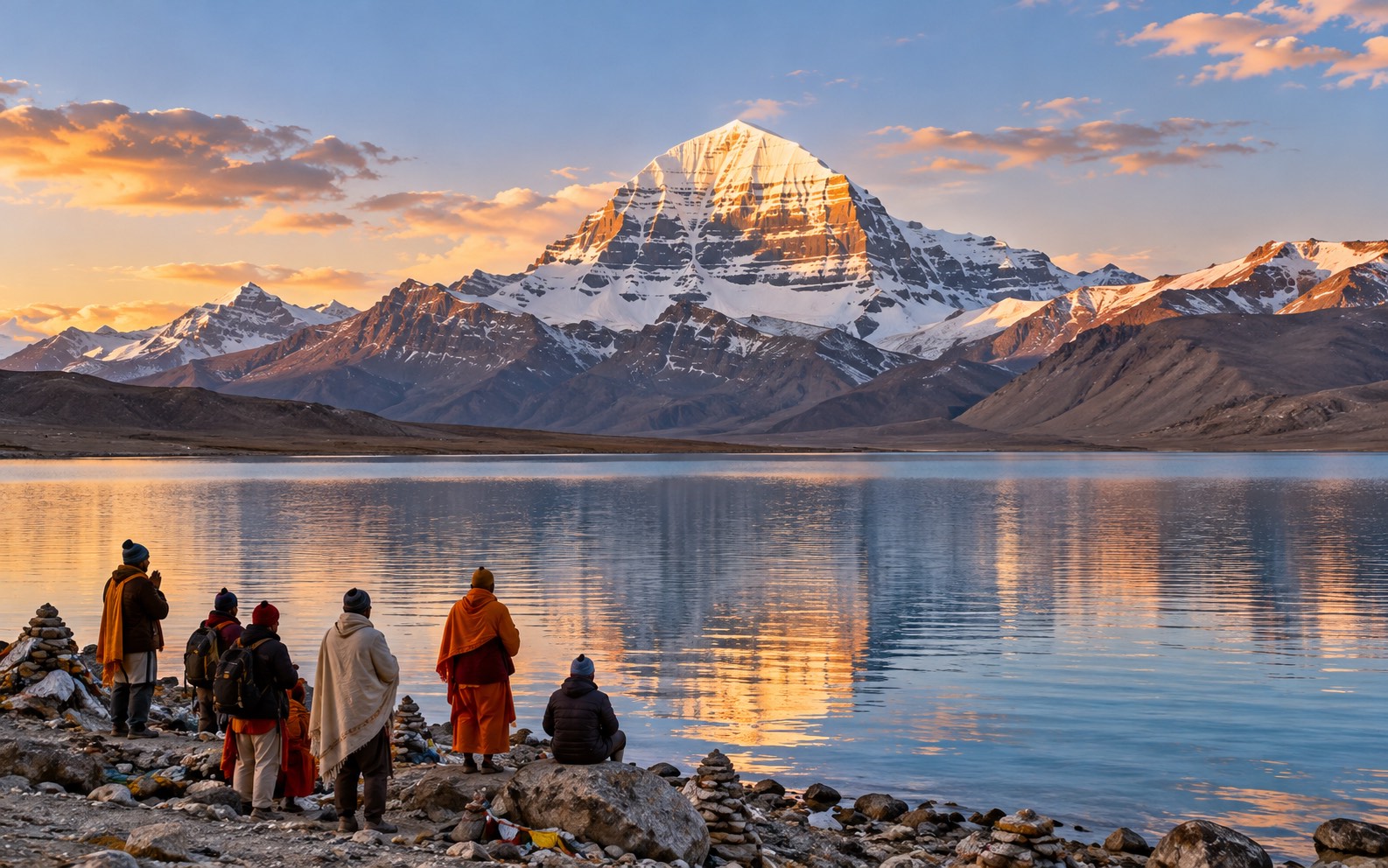
There are taller mountains in the Himalaya. But no mountain holds the place that Mount Kailash does. For Hindus it is the home of Bhagwan Shiva and Mata Parvati. For Buddhists it is the abode of Demchok. For Jains it is Ashtapad, where the first Tirthankara, Rishabhdev, attained nirvana. For the ancient Bon religion of Tibet, it is the soul of the world.
Why has no one climbed it?
Mount Kailash (about 6,638 m) has never been climbed. In the 1980s, the famous mountaineer Reinhold Messner was reportedly offered the chance — and refused out of respect. Later attempts were not permitted, and climbing the mountain is now banned by Chinese authorities. The reason is simple: for over a billion people, Kailash is not a summit to conquer but a deity to circle.
Climbers who try to approach the summit are turned back by unseen forces, and time moves faster near the mountain.
There is no recorded ascent because climbing has been refused and then officially banned out of religious respect. Stories of hair and nails growing faster are popular, but no scientific study has shown this.
The source of four rivers
Within a short distance of Kailash rise four of Asia's great rivers: the Indus, the Sutlej, the Brahmaputra (Yarlung Tsangpo) and the Karnali, which becomes the Ghaghara and joins the Ganga. Ancient texts described Kailash as the centre of the world, from which life-giving waters flow in four directions — and the map agrees.
Two lakes: one holy, one fearsome
Below Kailash lie two lakes side by side. Mansarovar, round like the sun, is fresh water and considered the holiest lake in the world — created, it is said, from the mind of Brahma. Just beside it, Rakshas Tal, shaped like a crescent moon, is salty and still. Legend links it to Ravana, who is said to have done penance there. Yatris bathe in Mansarovar, never in Rakshas Tal.
The face of Kailash
The mountain's four faces are said to be made of crystal, ruby, gold and lapis lazuli. The south face has a long vertical groove crossed by horizontal rock bands, which many see as a giant swastika — an ancient symbol of good fortune in Hinduism, Buddhism and Jainism.
The parikrama
Instead of climbing, pilgrims walk around it. The outer kora is about 52 km and crosses the Dolma La pass at 5,630 m. Hindus and Buddhists walk clockwise; followers of Bon walk anti-clockwise.
- Height
- About 6,638 m (never climbed)
- Parikrama
- About 52 km over 3 days
- Season
- May – September
Questions
Has anyone climbed Mount Kailash?
No. There is no recorded ascent; climbing is not permitted out of religious respect.
Which rivers start near Kailash?
The Indus, Sutlej, Brahmaputra (Yarlung Tsangpo) and Karnali.
What is the difference between Mansarovar and Rakshas Tal?
Mansarovar is a freshwater lake considered holy; Rakshas Tal beside it is salty and associated with Ravana.